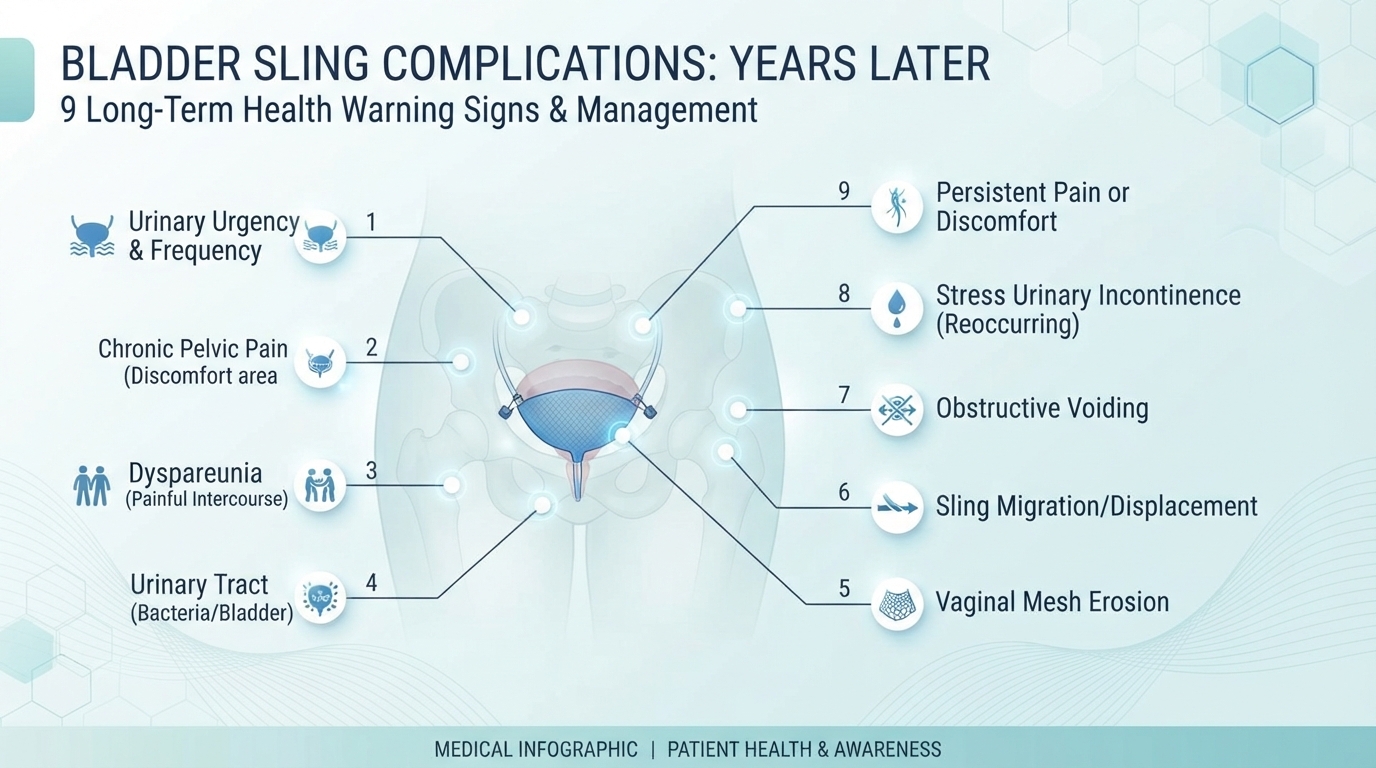
Solving Your Sling Story – Backstory If you’re like most women who underwent bladder sling surgery to cure what had previously been an inconvenient – and at times, downright embarrassing – part of your daily life – urine leakage when you cough, laugh, exercise, sneeze, lift weights – then you’re a fan of your sling. Surgery, in most cases, makes it disappear. But what if some of your original problems – including Pelvic pain; painful intercourse; urinary challenges; recurrent urinary tract infections; or even that familiar leakage problem – reappear much later down the line? A common and natural question arises: Could the sling be to blame?
Searching for bladder sling complications years later does not necessarily mean that a complication has occurred. Some symptoms that develop years after sling surgery have nothing to do with the implant. Others, however, can be related to the sling or to changes in the urinary tract and pelvic tissues around it.
That question is very important, because midurethral sling procedures do have large amounts of long-term research available to support them. They carry with them certain risks: studies showing many years of follow-up have described a variety of complications, includingmesh extrusion, urinary retention, pain, new urinary symptoms, and the need for surgery to revise or replace the incontinence procedure.
Simply looking at the timing cannot answer what happened: a detailed evaluation of symptoms and the type ofsling usedand how you were operated on as well as all subsequent events is necessary.
What a bladder sling actually does
A bladder sling is typically a remedy for stress urinary incontinence. Stress urinary incontinence is a leakage of urine that happens when an increase in pressure on the bladder causes leakage to occur. Coughing, sneezing, running, lifting, or jumping causes a rapid increase in the intra-abdominal pressure which can lead to urethral leakage.
A midurethral sling supports the urethra. In a common synthetic procedure, a narrow strip of mesh is positioned beneath the middle portion of the urethra. For people researching bladder sling complications years later, it helps to understand that the sling is designed to provide support when abdominal pressure rises while still allowing normal urination as the bladder empties.
Surgery involving a surgical mesh sling is a standard treatment for stress urinary incontinence, and the FDA guidance on surgical mesh slings provides information about their safety, effectiveness, and potential complications.
Not all slings are the same. There are retropubic, transobturator, single-incision (mini) slinging devices. Furthermore, there are non-mesh alternatives that use the patient’s own tissue.
This distinction can be critical when troubleshooting a problem decades later, since treatment options and complications are in part defined by what was placed in the pelvis.
Can bladder sling complications happen years later?
Yes. There can be sling-related complications that develop years after the primary surgical procedure.
This does not mean that a woman developing pelvic or urinary complaints years after the procedure necessarily has a failed sling or delayed surgical injury.
Long-term studies provide further context. In a 334,601 woman study of mesh sling surgery, the 10- and 15-yearsling revisionrisk was 6.9% and 7.9%, respectively. Mesh exposure accounted for almost half ofsling revisions.These findings provide useful context for people researching bladder sling complications years later, while also showing that revision surgery is not inevitable. The study found that repeat surgery for stress urinary incontinence occurred in 14.5% of women at 10 years and 17.9% at 15 years.
These numbers tell us about groups of women and not an individual’s personal risk. The figures represent varying reasons for repeat surgery. However, they illustrate a very important fact that the story of the sling is not one that ends when the initial recovery is finished.
However, large long term studies also illustrate that many women will continue to do well with their sling without needing revision.
A long term Swedish registry study of 10 years found that 79.2% were symptom improved and 63.3% were cured from incontinence. Persistence of sling related symptoms was reported by 17.7% and urinary retention was among the most common symptoms reported.
The correct interpretation must be the middle ground between sling are dangerous and a sling will never cause problems.
The most important late sling complications
The symptoms that appear years later can look very different depending on the underlying problem.
1. Mesh exposure or erosion
Mesh exposure One of the most serious complications of synthetic sling is mesh exposure. This is where the mesh works its way through the closest tissue – usually the vaginal tissue. Vaginal mesh erosion is explicitly mentioned by the FDA as a mesh sling complication and additional surgery may sometimes be warranted.
Women can suffer vaginal bleeding, discomfort, abnormal discharge, or pain when having sex or the problem will be discovered only during a routine GYN examination when there may be no symptoms at all Mesh is not always eroded “through the body” though – rather, the exact depth can matter.
Mesh exposure could potentially erode into the urinary tract in rare circumstances and is seen with other types of mesh sling repairs frequently enough. Mesh repair for such a problem varies depending upon the location, size, surrounding tissues and whether there is any indication of an infection and whether the Sling is needed to correct incontinence.
2. Pelvic or groin pain

The presence of pain is possible post operatively and in some women it might become a or important late complication. The location may give some indicators. Depending on the method of sling implantation there may be discomfort in the vagina, pelvic region, suprapubic region, supra pubic area, groin, lower abdomen, or at the superior inner thigh. A recent systematic review (2024) on synthetic mid-urethral slings complications mentioned the complications reported included pelvic/suprapubic/perineal pain. This systematic review reported some discrepancies in reported complication patterns between the retropubic and trans-obturator approach.
The presence of pain can be indicative, but it doesn’t prove that the mesh is necessarily responsible. Musculoskeletal issues, pelvic floor dysfunction, nerve irritations, gyneo and urinary complaints could all present with similar symptoms. This is the rationale behind trying something else before simply removing a sling because the woman has pain.
3. Difficulty emptying the bladder
If your sling is too tight around your urethra, it can prevent your bladder from completely emptying. Some women develop urinary retention shortly after surgery; others develop ongoing or recurring urination problems months or years later. Long-term studies have identified urinary retention as a significant problem with slings.
For example, 16 percent of the 2,727 women participating in the 10-year Swedish study reported ongoing sling-related voiding problems, and this symptom was among the more frequent.
Symptoms of urinary retention include a weak stream, straining, not emptying fully, feeling like you need to void again soon, or taking a long time to complete a cycle. A doctor can check your ability to empty your bladder by taking a postvoid residual measurement, a procedure designed to evaluate how much urine remains in the bladder after the woman voids.
4. New urgency or urge incontinence
However, urinary leak is not always stress incontinence. Urgency leakage occurs with a sudden, uncontrollable desire to micturate, followed by leakage. It is associated with overactivity of the bladder, and is not necessarily stress incontinence.
It is possible to develop new urgency or urgency incontinence following sling surgery.
Reviews of published literature list newly developed lower urinary tract symptoms, such as new urgency, as post-operative complications. This may be confusing as the sling may have achieved its aim of stopping leaking with coughing, and a different type of bladder problem arises instead. It is clinically important to differentiate between stress leakage, and urgency leakage, as the treatments differ.
5. Recurrent urinary tract infections
In Some Cases, New Problems Can Surface After Sling Surgery Sometimes repeated UTI’s can go hand in hand with problems emptying the bladder or exposure to an external substance. If you have a sling, it doesn’t mean every future UTI you have relates to the implant. UTIs can arise from a multitude of sources.
You can be years past your sling surgery with a UTI unrelated to your procedure.
But the presence of recurrent infections combined with an inability to void properly, pelvic pain, bleeding in the urine, or any other new urinary symptoms warrant a review by the clinician. He or she will evaluate for urinary retention or infection, abnormalities in the bladder and, rarely, involvement of the urinary tract by the mesh. 6. Pain With Intercourse Painful intercourse, or dyspareunia, can also follow placement of a sling, whether surgically or not. Pain may arise in vaginal tissues, pelvic floor muscles, from scarring, frommesh exposure, or involve deeper pelvic elements.
Since Painful intercourse is such a common and wide-ranging problem, it shouldn’t be automatically presumed to be related to mesh.
Symptoms can be similar to Postmenopausal thinning and dryness of vaginal tissue, muscle tightness or overactivity in the pelvic floor, vaginal infections, other pelvic infections, vaginitis, pelvic masses, endometriosis and many others gynecologic issues. A pelvic examination may be performed to distinguish among those possible sources of painful intercourse.
Why symptoms can appear long after surgery
A delayed symptom doesn’t mean the sling suddenly started to ‘fail’ you- there can be several processes occurring to explain that. First the urinary tract may have altered its state over time -aging, menopause, prior delivery history, changes to the pelvic floor muscles, neurological disorders, medications or other physical conditions all alter how bladder function works. Second– stress incontinence might recur- the sling is still working and performing its function, but the tissues around it have changed.
Or she might have a completely new type of incontinence.
Third — mesh exposure is also something that can occur at a later stage– complications don’t have to be present within the first weeks of surgery-Fourth, the original problem maybe was just one component of a more extensive pelvic problem; dealing with stress incontinence does not prevent another subsequent condition like overactive bladder, pelvic organ prolapse, recurrent UTIs or any other disorder of the pelvis. That is why the expression years later is the interesting thing from a clinical viewpoint and not a diagnosis in itself.
The type of sling changes the risk profile
The two main techniques for conventional midurethral slings are the retropubic and the transobturator approach. One type of slings are the retropubic slins that go around the pubic bone toward the lower abdomen, the other type are the transobturatorslins going through the groin tissues. There seems to be an difference between the type of complications of these types of slings in several studies.
Some of them indicates that retropubic slings are correlated to more blunt injuries (i.e bladder injuries) whereas some pain side-effects are to be found more often after the transobturator procedure.
Knowing that is an advantage if you’re looking to an operation which was done many years ago and it is not to be misinterpreted that any of them is more dangerous than the other. For instance there wasn’t found any differences between the two methods concerning the overall complication rate, rate of reoperation due to complications or even quality of live score on a prospective Swedish study of 10 years, except of the effectiveness of retropubic slings.
What symptoms should raise suspicion of a sling problem?
Certain combinations deserve particular attention.
For instance, a woman who had a sling procedure eight years ago and is now experiencing occasional leakage during runs might have an ongoing episode of stress incontinence. Not so with continuous pelvic pain, discomfort with intercourse, any bleeding or vaginal discharge, inability to urinate normally, or having a feeling that there is something rough or even sharp exposed within the vagina. The FDA suggests consulting a health care professional if you encounter an issue with your procedure – which they list as sustained vaginal bleeding or discharge, pelvic or groin pain or pain during sexual intercourse – in addition to seeking regular follow-up and disclosing the existence of a sling to your doctors prior to other interventions.
But again, symptoms like these do not signify that there has been a sling complication.
It merely means the situation warrants a closer look.
How a doctor evaluates suspected sling complications
The evaluation usually begins with a detailed history.
It’s possible that the clinician asks the date of onset of symptoms, whether the pain started quickly or slowly, if it occurred with urination or sexual contact, and whether the first surgery was with mesh.
Physical exam can give a lot of information. With a pelvic examination, possible mesh extrusion, vaginal changes, pain/tenderness, prolapse of organs, and other conditions can be assessed. Urinalysis is helpful if an infection is suspected.
If a man or woman does not empty the bladder completely, this can be documented using a postvoid residual study. If indicated by the particular symptoms, cystoscopy, urodynamic testing, and imaging such as ultrasound may be performed, but these don’t have to be done for every woman or man receiving a sling. The objective in the physical exam as well as the history is to answer the question of why do these symptoms occur?
Does a sling always need to be removed if it causes problems?
No.
You or your doctor need to considersling revision or mesh removal,which might involve entirely cutting, partial removal, or re-tucking of the mesh. The optimal approach depends on the complication. For example, perhaps a very small mesh exposure into the vagina might be treated differently from a sling which is causing complete obstruction or chronic terrible pain.
You also have to consider the result of removing the sling.
If you had stress urinary incontinence due to urethral collapse supported successfully by a mesh which has moved, then without replacement you could have a recurrence. A systematic review by parsons etal demonstrated that removal of mesh, often due to exposure, is done, with a variable success rate as mesh removal might not be complete and in fact one might lose coverage that is achieved by the mesh [42]. This may then result in failure.
What about bladder sling failure years later?

Often the problem isn’t an injury, but that the Sling no longer works. An operation with the mesh sling often has no problems for many years, but then may suddenly fail as a new case of stress incontinence begins. This does not indicate that the sling has ruptured.
In some women long-term follow-up studies have identified that a repeat incontinence procedure may be necessary at some time in 10 year follow ups (Swedish study and large USA series for SUI), due to new factors in the pelvic support, aging, or advancement of the underlying illness.
Before addressing a possible further surgery the practitioner may first ascertain that the woman actually is experiencing stress urinary incontinence.
A common mistake: assuming every pelvic symptom is caused by the mesh
One of the other largest diagnostic difficulties with a long-standing sling symptom is interpretation.
Imagine, for example, that a woman presents with pelvic pain 12 years after surgery, with a sling being an obvious potential culprit as it is a concrete, tangible presence of a previous operation.
However, muscles, nerves, joints, reproductive organs, urianry disease, bowel disease, infection, or other sources can be contributing to pain.
Similarly urinary urgency can be seen as a result of an overactive bladder, infection, medications,menopause and related issues, or neurological cause.
A sling then becomes part of the medical history, not the actual diagnosis.
A good diagnostic workup will keep both the potential sling and other factors in mind, including broader pelvic health and wellness concerns.
What you should bring to an appointment
If you can obtain them, look for an operative report or medical records of the original surgery.
This document will show what type of sling it was (synthetic mesh or autologous tissue), the type of surgery, when the sling was implanted and if complications arose from the immediate recovery period.
If these records are no longer available, the condition can still be assessed. Tell the clinician approximately when the surgery took place and what you can recall.
Accurately describing signs of the condition can also be helpful.
“Problems with my bladder” is less specific than ” I leak when I cough, but not when I experience an abrupt, sudden desire to urinate.”
Similarly, “pelvic pain” is less specific than “I have pain in the deepest part of my vagina during sex, and a nagging, dull ache on the left side.”
Such clear observations can aid the clinician in identifying specific behaviors.
When sling symptoms need prompt attention
Certain issues can’t and should not be put off until some unknown point down the line: ongoing vaginal bleeding any discharge with an unusual appearance or odor pain in the groin and pelvic area painful sex trouble fully emptying your bladder recurrent urinary infections blood in your urine a meshy feeling inside your vagina If you’re worried you have a problem with your mesh you should definitely report that to your doctor – she can let you know if you need to see a specialists with experience in this kind of mesh problem.
“If someone is experiencing significant pain, difficulty passing urine, a high temperature alongside significant pelvic or urinary symptoms, significant bleeding, or rapidly worsening symptoms, they need urgent medical evaluation,” says the FDA.
What the long-term evidence actually tells us
Long-term research on bladder sling complications years later does not support the idea that bladder slings routinely deteriorate into complications after a certain number of years.
Instead, the evidence shows a mixture of durable benefit and a smaller but meaningful risk of complications.
One large study found a 15-year cumulative sling-revision risk of 7.9%, with nearly half of revisions associated with mesh exposure.
Another 10-year study found that most women reported improvement after midurethral sling surgery, although some continued to experience sling-related symptoms, urinary retention, mesh exposure, or subsequent surgery.
The FDA’s review of mini-slings likewise found comparable effectiveness and similar types and rates of adverse events and re-surgery compared with traditional midurethral slings through the studied follow-up periods.
The practical lesson is straightforward: a sling can remain effective for many years, but long-term symptoms should not be ignored simply because the surgery was performed a long time ago.
Conclusion: What to do about bladder sling complications years later
Bladder sling complications years later are possible, but a new symptom does not automatically mean the sling is responsible. Long-term research shows that many women continue to benefit from midurethral sling surgery, while a smaller proportion develop problems such as mesh exposure, urinary retention, pelvic pain, new urinary symptoms, or the need for revision.
The most helpful distinction is that there has been a complication of the sling procedure, the original incontinence has returned or there is a separate urinary or pelvic problem. Although these may feel very similar, each necessitates a different treatment.
In the event of new or persistent pelvic or groin pain, vaginal discharge or bleeding, pain with sexual intercourse, inability to empty the bladder, new or recurrent urinary symptoms or recurent leakage, see your doctor for evaluation rather than trying to determine on your own if you are having a sling complication. This is the standard that the FDA recommended be included when any of these symptoms present.
When asling complication is the diagnosis, seeing a urogynecologist or another provider with expertise in pelvic floor and mesh complications can facilitate more accurate examination. Removal is not always the answer; the objective is to identify and appropriately and conservatively treat the problem.
Frequently Asked Questions
1. Can a bladder sling cause problems 10 years later?
Yes. A few issues associated with surgical slings can become evident months or years after surgery, such asMesh erosions Mesh may be exposed The inability of the bladder to empty completely (urinary retention) pain Sling malfunction that necessitates revision. However, the symptoms of a few that appear a number of years after may be attributable to other causes. Long-term analyses generally find most women remain satisfied long after Sling surgery A few may have need forslingrevision or second incontinence procedures.
2. What are the most common bladder sling complications years later?
Potential late problems include mesh exposure, pelvic or groin pain, painful intercourse, urinary retention, new urgency or urge incontinence, recurrent urinary symptoms, and recurrent stress urinary incontinence. The specific risk depends on the sling type and individual circumstances.
3. Can a bladder sling cause frequent urination?
A sling can be associated with new lower urinary tract symptoms, including urgency and other changes in urination. However, frequent urination has many other possible causes, such as overactive bladder, urinary infection, medications, or age-related changes. A urine test and clinical evaluation can help distinguish these possibilities.
4. How do I know if my bladder sling has eroded?
Mesh exposure may cause vaginal bleeding, unusual discharge, pelvic discomfort, pain during intercourse, or a sensation of exposed material. Some cases are found during a pelvic examination even when symptoms are mild. A clinician needs to examine the area to determine whether mesh exposure is actually present.
5. Does a bladder sling need to be removed if I have pain?
Not necessarily. Pain may or may not be caused by the sling, and removal can have consequences, including recurrence of stress urinary incontinence. The cause and location of the pain should be established before deciding whether sling revision or removal is appropriate.
6. Can bladder leakage return years after a sling?
Yes. A sling can remain intact while stress urinary incontinence returns. Long-term studies have documented repeat surgery for stress incontinence after midurethral sling procedures. Recurrence does not necessarily mean that the sling has broken or eroded.
7. Who should evaluate suspected sling complications?
Evaluation A first step towards evaluation could be undertaken by a Gynecologist, Urologist or a Uro-gynecologist. If mesh complications seem likely the FDA recommends that the patients receive the opinion of a surgeon with extensive experience in female pelvic reconstruction if this seems appropriate.